
14 minutes
Pool Fence Requirements in Central Florida: A Homeowner’s Complete Guide
A clear breakdown of Florida’s pool-barrier laws, gate requirements, permits, material options, and special rules Central Florida homeowners should understand before installing a fence.

If you own a swimming pool in Central Florida—or you are planning to build one—the fence around it is more than a privacy feature. It may serve as a legally required safety barrier designed to prevent children and other vulnerable individuals from gaining unsupervised access to the water.
Florida establishes minimum residential pool-barrier standards, but the final requirements for your property can also depend on your city or county, zoning district, lot configuration, HOA, easements, and whether the home borders a lake or waterway.
That combination is where homeowners often get confused. A fence that is perfectly acceptable as a standard backyard fence may not qualify as a pool barrier. The height may be sufficient while the gate, spacing, ground clearance, or surrounding layout fails inspection.
This guide explains the most important pool fence requirements for homeowners throughout Central Florida, including Oviedo, Winter Springs, Sanford, Orlando, Winter Park, Lake Mary, Apopka, Chuluota, Lake Nona, and the surrounding communities.
Important: This article provides general information based on current Florida requirements and local government guidance. Every property should be reviewed individually before materials are ordered or installation begins.
Quick Answer: What Does a Pool Fence Need in Florida?
In most residential applications, a permanent fence used as a swimming pool barrier should be designed around the following core requirements:
A minimum barrier height of 48 inches, measured from the side facing away from the pool
No openings that allow a 4-inch-diameter sphere to pass through
Limited clearance between the finished grade and the bottom of the barrier—commonly no more than 2 inches
A barrier design that does not provide an easy path for a young child to climb over, crawl under, or squeeze through
Pedestrian gates that open away from the pool
Gates that are self-closing and self-latching
A properly positioned or protected gate-release mechanism (minimum of 54" from ground)
A barrier located far enough from the water’s edge that a person who gets through it does not immediately fall into the pool
These are not the only details that may apply. Fence construction, horizontal rails, picket spacing, decorative openings, chain-link mesh, screen enclosures, above-ground pools, doors from the home, and waterfront properties can create additional requirements.
Florida’s Residential Swimming Pool Safety Requirements
Florida’s Residential Swimming Pool Safety Act requires a new residential swimming pool to include an approved safety feature before it can pass final inspection and receive a certificate of completion.
Under Florida Statute 515.27, a qualifying residential pool must use at least one approved safety option. Depending on the project, this can include:
An enclosure that isolates the pool from the home
An approved safety pool cover
Alarms on doors and windows that provide direct access to the pool
Self-closing and self-latching devices on doors that provide direct pool access
A qualifying swimming pool alarm
The exact compliance method must be approved for the project. A homeowner should never assume that a door alarm, removable mesh fence, screen enclosure, or backyard perimeter fence automatically satisfies every applicable requirement.
What Qualifies as a Pool Barrier?
A pool barrier can be a fence, wall, screen enclosure, part of the dwelling, or an approved combination of those components. Its purpose is to completely restrict unauthorized access to the pool area.
Florida law generally requires the barrier to surround the pool and remain separate from a general yard enclosure unless the yard fence—or a portion of it—is positioned and constructed to serve as the required pool barrier.
This means a perimeter fence can sometimes serve both purposes, but only when the entire relevant barrier system complies. Inspectors do not look only at the fence panels. They also evaluate gates, doors, windows, transitions between materials, clearances, nearby climbable objects, and any location where the barrier terminates.
Minimum Pool Fence Height in Florida
The minimum height for a residential pool barrier is generally 4 feet, or 48 inches, measured on the side of the barrier facing away from the pool.
Many Central Florida homeowners choose a 5-foot aluminum fence or a 6-foot privacy fence instead. Both can potentially satisfy the minimum-height requirement, provided the entire design complies with local zoning and pool-safety standards.
Taller is not automatically better from a permitting standpoint. Front yards, street-side yards, corner lots, visibility triangles, waterfront areas, and certain planned communities may limit where a 5-foot or 6-foot fence can be installed.
Pool Fence Openings and Ground Clearance
The barrier cannot contain an opening large enough for a 4-inch-diameter sphere to pass through. This rule affects more than the spacing between aluminum pickets. It also applies to gaps:
Below the fence
Between a gate and gate post
Where two gates meet
At changes in elevation
Beside a wall, column, or screen enclosure
Where the fence terminates at the house
The typical maximum clearance between the finished grade and the bottom of the barrier is 2 inches when measured from the side away from the pool.
Central Florida’s uneven grades, drainage swales, roots, pavers, retaining walls, and sloped lots can make these clearances difficult to maintain. A fence may look level from a distance and still leave a noncompliant opening at one low point.
That is why a pool fence should be laid out around the actual finished grade—not installed as though every yard is flat.
Pool Gate Requirements
The gate is one of the most important parts of a compliant pool barrier and one of the most common sources of inspection problems.
A pedestrian gate serving the pool area should:
Open outward, away from the pool
Close automatically from an open position
Latch automatically without someone manually engaging the latch
Use a release mechanism positioned or protected as required by code
Maintain compliant spacing beneath the gate and along both sides
Remain properly aligned so the latch operates consistently
A gate that closes only when pushed, drags on the ground, or misses the latch is not functioning as a true self-closing, self-latching gate.
Hardware selection matters, but so does the structure supporting it. Gate posts need to remain stable enough to preserve the required clearances and alignment over time. For aluminum pool gates, quality hinges and a purpose-built magnetic or mechanical pool latch are typically better suited to the job than ordinary residential gate hardware.
Can a Double Gate Be Part of a Pool Fence?
Double gates can be used in some pool-barrier layouts, but they require careful design. The active leaf must satisfy the applicable self-closing and self-latching requirements, while the inactive leaf must remain securely fixed in place when it is not being used.
The center gap, bottom clearance, drop rods, receivers, hinges, and latch all need to work together without creating an opening or an easy way for a child to release the gate.
Because a double gate has more moving parts than a single pedestrian gate, it is especially important to identify the intended pool-barrier function before the gate is fabricated or installed.
Best Fence Materials for a Pool in Central Florida
Several materials can be used around a residential pool, but each has advantages and design considerations.
Aluminum Pool Fencing
Aluminum is one of the most popular choices for Central Florida pools because it provides visibility, resists rust, and creates a clean appearance without blocking the view of the water.
A properly designed aluminum pool fence can work well for:
Pools overlooking lakes or conservation areas
Homes where visibility from the patio is important
Modern and traditional properties
Homeowners who want lower maintenance
The picket spacing, rail placement, gate hardware, grade clearance, and proximity to electrical bonding zones all need to be evaluated for the specific project.
Vinyl Pool Fencing
Vinyl is a strong option when the homeowner wants both pool security and privacy. It does not rot, requires limited maintenance, and performs well in Florida when manufactured from quality materials and installed correctly.
The most important considerations are gate reinforcement, post stability, wind exposure, drainage, and maintaining code-compliant clearances at the bottom and sides of the gate.
Wood Pool Fencing
Wood can also serve as a pool barrier when it is built to the required height and spacing and does not create an easily climbable design.
In Florida’s heat, rain, and humidity, wood movement must be considered. Pickets can shrink, gates can change alignment, and soil conditions can affect posts. A site-built fence allows the installer to respond to the actual grade and layout, but the design and maintenance still need to preserve the required openings and gate operation.
Chain-Link Pool Fencing
Chain-link may be permitted when its mesh size, height, gates, and overall construction meet the applicable pool-barrier standards. Standard chain-link products are not automatically pool compliant, so the exact specification must be confirmed before installation.
Does a Screen Enclosure Count as a Pool Barrier?
A properly designed and approved screen enclosure may serve as part of the pool-isolation system. However, the enclosure must satisfy the applicable Florida Building Code requirements, and any doors leading through it must use appropriate self-closing and self-latching hardware.
If the house forms one side of the enclosure, doors and windows that provide direct access to the pool may require additional protection, such as approved alarms or qualifying door hardware.
A standard patio screen door should not be assumed to qualify without review.
Above-Ground Pools, Hot Tubs, and Spas
Above-ground pools are not automatically exempt from barrier requirements. In certain designs, the pool wall itself may serve as part of the barrier when it has the required height and restricts access. Ladders, steps, decks, and platforms must then be removed, secured, enclosed, or otherwise protected as required.
Hot tubs and spas may qualify for different compliance options when equipped with an approved safety cover, but homeowners should confirm the exact requirement with the local building department.
Even temporary or inflatable pools can trigger safety and permitting rules. The City of Orlando, for example, states that a properly permitted fence is required for a pool at least 2 feet deep with an area of at least 36 square feet, including inflatable pools.
Do You Need a Permit for a Pool Fence in Central Florida?
Often, yes—especially when the fence is being used as the required pool or spa barrier.
Permit exemptions that may apply to certain ordinary residential fences should not be treated as a blanket exemption for a required life-safety barrier. The local building department may need to review the fence in connection with the pool permit, a separate fence permit, or both.
For example, the City of Orlando’s fence guidance specifically identifies a fence used as a required pool or spa barrier as a condition requiring a fence permit. Orlando also identifies other permit triggers, including corner lots, public easements, vehicular gates, certain materials, and fences taller than 6 feet.
Seminole County’s pool-safety affirmation requires the chosen barrier method to be identified for the pool project. Its fence-submittal checklist also asks whether the proposed fence will satisfy the residential swimming-pool barrier requirement.
Requirements may differ among:
Unincorporated Seminole County
Unincorporated Orange County
The City of Oviedo
The City of Winter Springs
The City of Sanford
The City of Orlando
The City of Winter Park
The City of Lake Mary
Other incorporated municipalities
The authority having jurisdiction over the property—not simply the mailing address—determines which local process applies.
Waterfront Pool Fence Requirements
Lakefront homes require special attention. Open water is not automatically accepted as a complete pool barrier, and a fence that stops at the shoreline may leave the pool accessible from an adjacent property.
Seminole County’s current pool-safety affirmation states that, on property next to a lake or waterway, pool-barrier fencing must extend 3 feet into the water beyond the lowest water level. The backyard fence may be placed near the lake only when it also complies with applicable zoning setbacks.
Water levels change throughout the year, so designing the termination based only on the waterline visible on installation day can create a future gap. Wetland buffers, conservation easements, shorelines, seawalls, and HOA restrictions may also affect the layout.
HOA Approval and Pool Fence Rules
Building-code compliance and HOA approval are separate issues.
An HOA may regulate items such as:
Approved fence materials and colors
Maximum fence height
Whether privacy fencing or aluminum fencing is allowed
How close the fence may be to the front of the home
Fence placement on corner or waterfront lots
Required landscaping or screening
HOA approval does not replace government review, and government approval does not automatically override private deed restrictions. The safest approach is to design a layout that accounts for both processes before ordering materials.
Common Reasons Pool Fences Fail Inspection
Many failed inspections involve small details rather than the overall appearance of the fence. Common issues include:
The gate does not close and latch by itself.
The gate swings toward the pool instead of away from it.
The latch or release mechanism is too low or accessible through an opening.
A gap under the fence or gate is too large.
The space where the fence meets the house, wall, or screen enclosure is too wide.
Decorative openings or picket spacing do not satisfy the barrier standard.
A bench, air-conditioning unit, planter, retaining wall, or other object creates a climbable condition beside the fence.
The approved plan shows a different barrier configuration from what was installed.
A double gate is not properly secured.
A lakefront fence terminates before the required point.
Most of these problems are easier and less expensive to prevent during planning than to correct after the fence is complete.
How to Plan a Code-Compliant Pool Fence
Before requesting a final fence quote, gather the following information:
A clean property survey
The proposed pool and deck plan
The location of the house, screen enclosure, doors, and windows
All easements, drainage areas, setbacks, and property lines
The intended fence material and height
The location and width of every gate
Any HOA fence guidelines
Information about lake, canal, wetland, or conservation boundaries
The fence contractor, pool contractor, and permitting authority should all be working from the same approved layout. When those plans conflict, the issue should be resolved before installation—not during the final pool inspection.
Choosing the Right Pool Fence for Your Home
The right pool fence should do more than meet the minimum height. It should fit the property, operate reliably, complement the home, and maintain compliant openings across the actual grade.
For many Central Florida homes, aluminum provides the best balance of visibility and low maintenance. Vinyl is often the stronger choice when privacy is the priority. Wood can create a custom, natural appearance when it is properly designed, built, and maintained.
The best material ultimately depends on the pool layout, HOA rules, desired privacy, grade changes, gate sizes, waterfront conditions, and local permitting requirements.
Need Help Planning a Pool Fence in Central Florida?
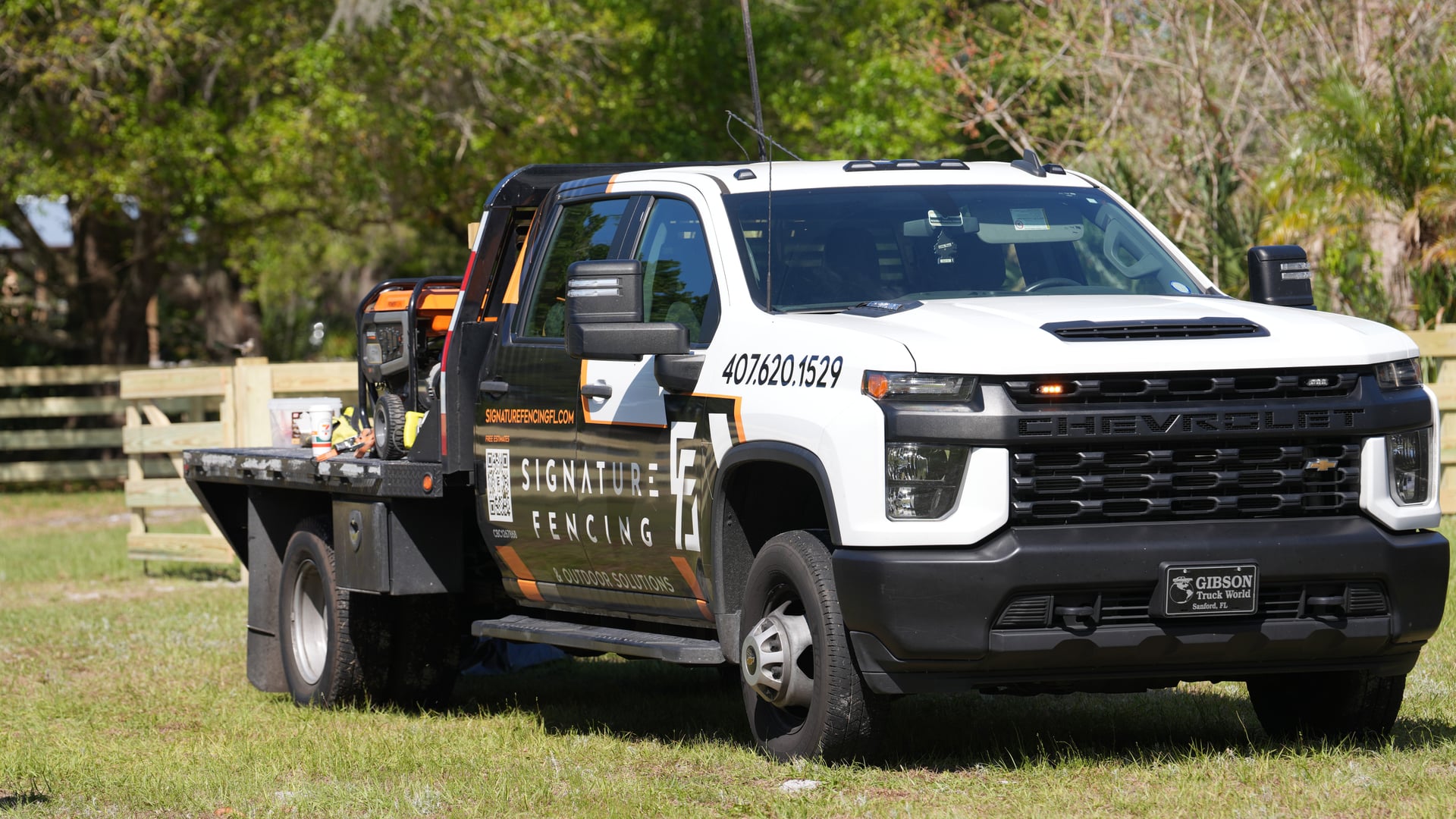
Signature Fencing, LLC installs aluminum, vinyl, wood, chain-link, and other fencing systems throughout Central Florida. As a Florida Certified Building Contractor (CBC1267868), our team can review your survey, proposed layout, gates, grade changes, and local requirements to help you plan the right fence for your property.
We proudly serve homeowners in Oviedo, Winter Springs, Sanford, Orlando, Winter Park, Lake Mary, Apopka, Chuluota, Lake Nona, and surrounding Central Florida communities.
Request a fence estimate from Signature Fencing today. Send us a clean copy of your property survey, and we can begin reviewing the dimensions and layout for your project.
Frequently Asked Questions
How tall does a pool fence need to be in Florida?
A residential swimming pool barrier generally must be at least 48 inches high when measured from the side facing away from the pool. Local zoning or HOA rules may affect where fences of different heights can be placed.
Does a 6-foot privacy fence count as a pool fence?
It can, but height alone does not make it compliant. The openings, bottom clearance, gate direction, self-closing hinges, latch, transitions, and overall barrier layout must also meet the applicable requirements.
Do pool gates have to swing outward in Florida?
Pedestrian access gates serving the pool barrier generally must open outward, away from the pool, and must be self-closing and self-latching.
Can my house be part of the pool barrier?
Yes, in an approved design. Doors and windows that provide direct access from the home to the pool may require alarms, self-closing and self-latching hardware, or another approved safety method.
Can an aluminum fence be used around a pool?
Yes. Aluminum is one of the most common pool-fence materials in Central Florida. The fence style, picket spacing, rail configuration, gates, clearances, and installation must satisfy the applicable barrier requirements.
Does a pool fence need a permit in Orlando?
The City of Orlando identifies a fence used as a required pool or spa barrier as requiring a fence permit. Additional permit triggers may also apply based on the lot, fence material, height, easements, and gate type.
Can my backyard fence serve as the pool barrier?
Potentially. The relevant portion of the perimeter fence must be positioned and constructed as part of the approved pool-barrier system and must satisfy all applicable barrier requirements.
Does a lake count as one side of the pool barrier?
Do not assume that it does. Waterfront properties are subject to special barrier and termination requirements. Seminole County currently requires pool-barrier fencing beside a lake or waterway to extend 3 feet into the water beyond the lowest water level.
What is the best fence material for a pool in Florida?
Aluminum is popular for visibility and low maintenance, while vinyl is preferred for privacy. Wood offers a custom appearance, and chain-link may be suitable for certain projects. The best option depends on the property, HOA, gates, grade, budget, and local requirements.
What should I send to get a pool fence quote?
Send a clean, unmarked property survey along with the pool plan, preferred fence material, desired gate locations, and any HOA guidelines. This allows the layout and dimensions to be reviewed before a detailed quote is prepared.
Last Reviewed: August 2026
Official References: Florida Statute 515.27, Florida Statute 515.29, Seminole County Pool Safety Affirmation, City of Orlando Residential Pool Checklist, and City of Orlando Fence Guide.